

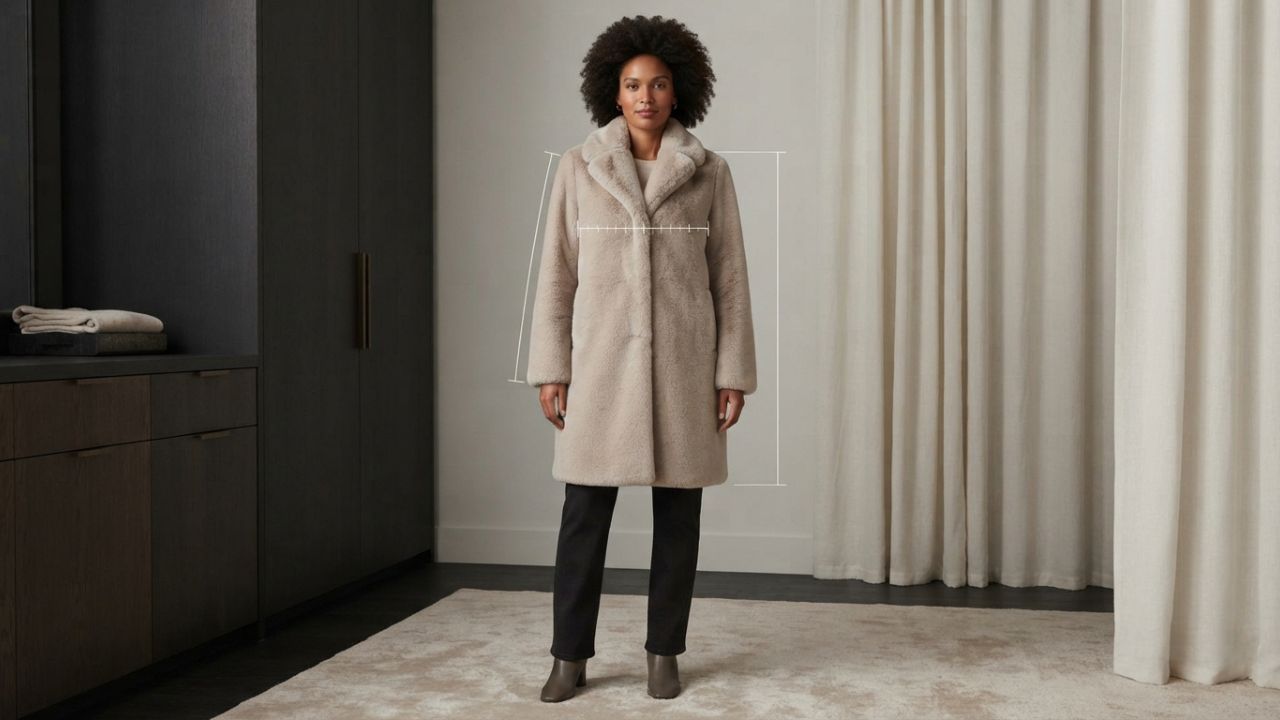
Choosing the right size can be the difference between a faux fur coat that looks polished and one that feels bulky, restrictive or simply wrong. This Faux Fur Coat Size Guide explains how to measure yourself, read a size chart, allow room for layers and decide between a closer or more relaxed fit before ordering online.
The important thing to remember is that the letter on the label is only a starting point. An M from one brand does not necessarily have the same measurements as an M from another. For faux fur especially, the cut, pile, lining, coat length and intended silhouette can all affect how the garment feels.
The safest approach is simple: measure yourself, compare those measurements with the specific product’s chart, then think about how you actually plan to wear the coat.
How Should a Faux Fur Coat Fit?
A well-fitting faux fur coat should give you enough room to move your arms, close the front comfortably and wear the layers you normally use underneath.
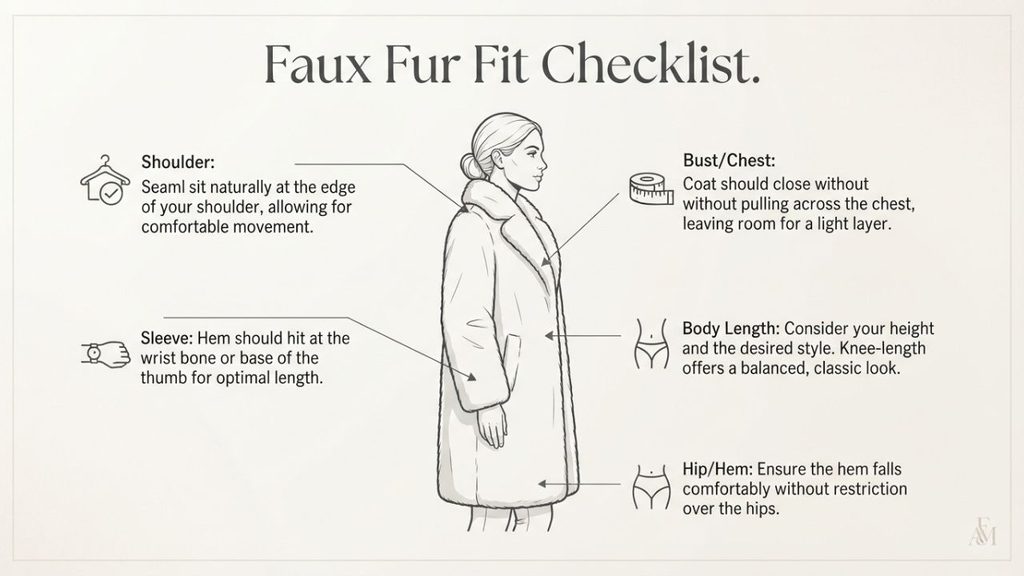
The shoulders deserve particular attention. If the shoulder area is too tight, you may feel pulling when you reach forward or cross your arms. If it is excessively wide, the entire coat can look larger than intended.
The chest is equally important because faux fur coats are outerwear. They should not fit like a thin blouse.
For everyday winter wear, check whether you can comfortably wear the type of sweater, knit top or dress you would normally pair with the coat.
The goal is not to make the coat skin-tight. It is to find a controlled amount of room that matches the design.
A shaggy faux fur jacket, for example, is naturally more visually substantial than a smoother faux mink fur jacket. That does not automatically mean you should order a larger size.
How to Measure Yourself for a Faux Fur Coat
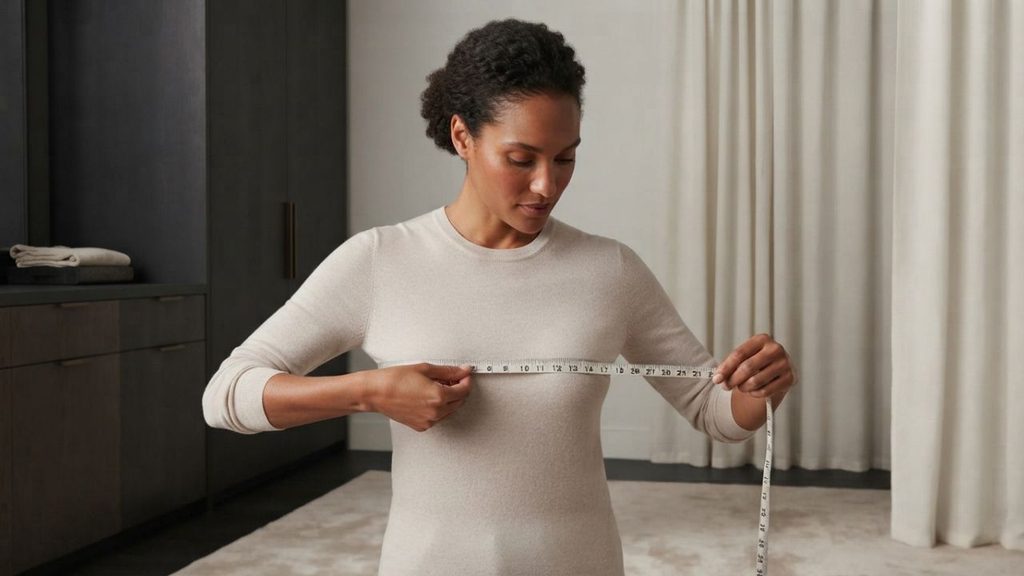
Before opening a size chart, take a few basic measurements. Use a flexible measuring tape and keep it comfortably against your body rather than pulling it extremely tight.
1. Bust or Chest
Measure around the fullest part of your bust or chest.
Keep the tape approximately level around your body. Do not hold your breath or deliberately compress the measurement.
For most coat shoppers, this is one of the most useful numbers because the garment needs enough room through the upper body for movement and layering.
2. Waist
Measure around your natural waist if the product’s chart includes waist measurements.
A waist measurement becomes particularly useful for shaped coats, belted styles and fitted faux fur jackets.
If the coat has a straight or oversized silhouette, waist measurements may be less decisive than chest and shoulder measurements.
3. Hips
For longer coats, measure around the fullest part of your hips.
This matters because a coat that fits comfortably around the bust can still feel restrictive lower down if its cut narrows toward the hem.
It is especially worth checking for long faux fur coats, belted silhouettes and coats intended to close completely.
4. Sleeve Length
Sleeve length can make a surprisingly large difference.
If the sleeves are too short, the coat may feel uncomfortable when you move your arms. If they are substantially too long, the hands can become buried inside the sleeves.
If the product page provides a sleeve measurement, compare it with a jacket or coat you already own and like.
How to Read a Faux Fur Coat Size Chart
This is where many online shoppers make their biggest mistake: they see “S,” “M,” “L” or “XL” and assume the label tells them enough.
It doesn’t.
A size chart may provide body measurements such as bust, waist and hips. Another may provide garment measurements such as chest width, body length and sleeve length.
Those are not interchangeable.
If a product page provides actual garment measurements, look carefully at how they were taken. If it provides body measurements, compare your own measurements directly against the stated range.
Do not compare a size number from one retailer with a size number from another retailer and assume the fit will be identical.
This is especially important with faux fur because construction and silhouette can vary substantially between a cropped faux fur jacket, a mid-length coat and a full-length style.
Should You Size Up in a Faux Fur Coat?
Not automatically.
Sizing up can make sense if you regularly wear thick sweaters underneath, prefer a relaxed silhouette or find that your measurements sit close to the upper end of a product’s recommended range.
But automatically ordering one size larger can create its own problems.
You may end up with:
- Excess fabric around the shoulders
- Sleeves that are too long
- A larger-looking upper body
- A hem that sits differently from the intended design
- More bulk than you actually wanted
Instead of asking, “Should I always size up?” ask:
What will I wear underneath, and how do I want the coat to fit?
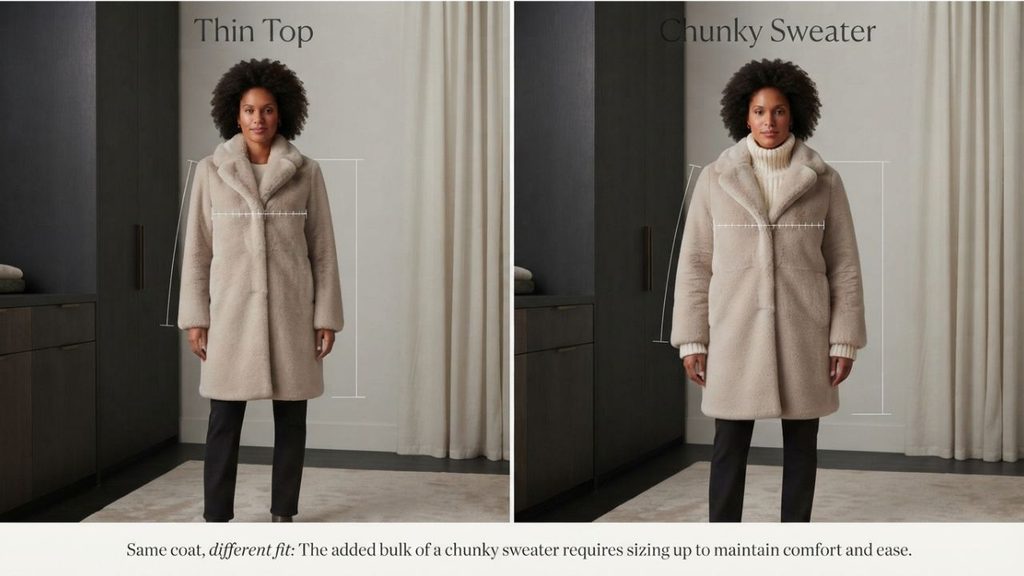
A fitted evening outfit may work well with a more controlled coat silhouette. A chunky sweater may require more room.
How Much Room Should You Leave for Layers?
Think about your real winter wardrobe.
If you live somewhere mild and usually wear a thin top beneath your outerwear, you may not need the same amount of room as someone who regularly wears chunky knitwear.
Try this simple rule when comparing your measurements:
Light layers → closer fit
Medium knitwear → moderate room
Heavy sweaters or multiple layers → more room
The coat should still move naturally.
You should be able to bend your arms, reach forward and close the garment without feeling that the fabric is fighting against your movement.
Do not add an arbitrary number of inches simply because a general sizing article says you should. The construction of the individual coat matters.
What If You Are Between Two Sizes?
This is one of the most common situations when shopping online.
If your measurements fall between two sizes, look at the garment’s intended fit before deciding.
For example, if the product is described as relaxed or oversized, the larger size may create considerably more volume than expected.
If the style is relatively fitted, the larger size may provide the room needed for comfortable layering.
Also consider which measurement is creating the problem.
If your bust measurement points toward one size but your waist is substantially smaller, a straight-cut coat may still work well. If your shoulders are broader, however, choosing a size based only on waist measurement can produce an uncomfortable upper-body fit.
For a coat, prioritize the areas that affect movement and closure.
Petite Shoppers: Does Coat Length Matter?
Yes.
A petite shopper does not necessarily need a smaller size. Height and body proportions are different from overall body circumference.
A petite woman can have the same bust measurement as a taller woman but need a different coat length or sleeve proportion.
Shorter styles, cropped faux fur jackets and coats that finish around the hip can sometimes create a more compact visual proportion.
That does not mean long coats are off limits.
A long faux fur coat can work beautifully on a shorter frame when its proportions are intentional. The key is to check the actual body and sleeve measurements rather than assuming “petite” automatically means “XS.”
Plus Size Faux Fur Coat Sizing
Plus-size shoppers should use the same measurement-first approach.
Do not assume that adding a larger letter automatically provides enough room everywhere.
Check the bust, waist and hip measurements, and pay particular attention to the garment’s cut.
A relaxed plus size faux fur jacket can provide a very different fit from a structured or fitted coat in the same nominal size.
If you plan to wear thick sweaters underneath, factor that into your decision.
The objective is a coat that closes comfortably and allows movement without requiring you to constantly adjust the garment.
What About Men’s Faux Fur Coat Sizing?
For a mens faux fur jacket or coat, chest measurement is often a particularly useful starting point, but it should not be the only consideration.
Check shoulder width, sleeve length and body length whenever those measurements are available.
Men’s faux fur coats can range from shorter bomber-inspired shapes to long statement coats, and the intended silhouette changes how much room is appropriate.
A close-fitting jacket worn over a shirt is a different sizing problem from a long coat intended to be worn over a sweater.
Short vs Long Faux Fur Coats
Size is only part of the decision. Coat length changes the overall proportion of an outfit.
A cropped faux fur jacket usually finishes around the waist or hip and can work well with high-rise trousers, jeans and skirts.
A mid-length faux fur coat gives you more coverage while remaining relatively easy to style.
Long faux fur coats create a stronger vertical line and can feel more substantial, particularly when paired with boots and streamlined clothing.
Before choosing your size, think about the relationship between your height, the coat length and the clothes underneath.
For a deeper comparison of proportions and styling, see our guide to Short vs Long Faux Fur Coats.
Common Faux Fur Coat Sizing Mistakes
Choosing by label alone
An “L” is not a universal measurement.
Always compare the actual chart.
Ignoring the shoulders
A coat can have enough room through the body and still feel wrong because the shoulders are too tight or too wide.
Forgetting about sleeves
Sleeve length becomes especially noticeable when you are wearing a coat regularly.
Ordering oversized by accident
An oversized look should be intentional. Simply buying a larger size does not always recreate the silhouette shown in product photography.
Measuring incorrectly
Keep the tape level and avoid pulling it excessively tight.
Ignoring coat length
Two coats in the same size can look completely different because one is cropped and another reaches the knee or calf.
A Simple Faux Fur Coat Size Checklist
Before placing your order, check these six things:
- Your bust or chest measurement.
- Your waist and hip measurements where relevant.
- Sleeve length if provided.
- The product’s actual size chart.
- The layers you expect to wear underneath.
- The coat’s length and intended silhouette.
If all six make sense together, you are making a much more informed decision than simply ordering your usual letter size.
Choosing Your Size at Faux Fur World
At Faux Fur World, our approach to faux fur sizing is centered on giving shoppers useful product information rather than asking them to guess from a generic label.
The brand focuses on faux fur coats, faux fur jackets and winter outerwear, with options ranging from shorter statement jackets to longer coat silhouettes.
Our goal is to offer what we position as the most affordable in the premium faux fur market, while keeping the buying process practical and straightforward.
When shopping, use the size chart attached to the specific product you are considering. If one coat has a different cut or silhouette from another, do not assume that the same size will create exactly the same fit.
That extra minute spent comparing measurements can save considerably more time later.
Final Takeaway
The best way to choose your size is not to guess from the letter printed on the tag.
Measure your body, compare those measurements with the specific product chart, think about what you will wear underneath and check the coat’s shoulder, sleeve and length proportions.
That is the core principle behind this Faux Fur Coat Size Guide.
A good faux fur coat should have enough room to move and layer without becoming unnecessarily bulky. The right size also depends on the silhouette you want: a cropped faux fur jacket, mid-length coat and long faux fur coat will naturally create different proportions.
If you are comparing styles, continue with our Short vs Long Faux Fur Coats guide to understand how coat length can affect styling and proportions before making your final choice.
Frequently Asked Questions
Q. What size faux fur coat should I buy?
Start with your body measurements and compare them with the specific product’s size chart. Pay particular attention to bust or chest, shoulders, sleeve length and the layers you plan to wear underneath.
Q. Should I size up in a faux fur coat?
Not automatically. Size up only when the product’s measurements, your preferred fit or your layering needs justify the additional room.
Q. How should a faux fur coat fit?
Measure your bust or chest, waist and hips where relevant. If the product provides sleeve measurements, compare those with a coat you already own that fits well.
Q. Does coat length affect what size I need?
Coat length itself does not determine your size, but it affects proportion and may make garment measurements such as body length and sleeve length more important.
Q. What if I am between two faux fur coat sizes?
Compare the garment’s intended fit and your layering needs. Look at which body measurement places you between sizes rather than automatically choosing the larger size.
Q. Is faux fur sizing different for petite shoppers?
Petite sizing is not simply about choosing a smaller letter. Height and proportions can affect sleeve and body length, so check those measurements when available.
Q. How should plus-size shoppers choose a faux fur coat?
Use the same measurement-first approach: compare bust, waist and hip measurements with the product chart and consider how much room you need for winter layers.

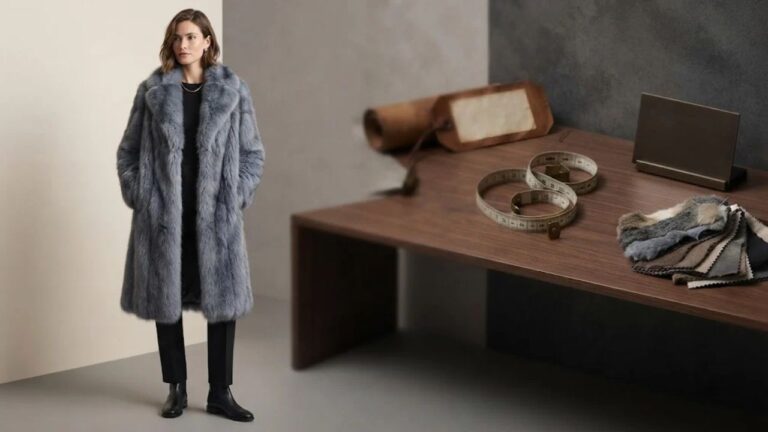


[…] additional help, read our Faux Fur Coat Size Guide before choosing your size. A coat should allow enough room for the clothing you plan to wear […]
Comments are closed.