

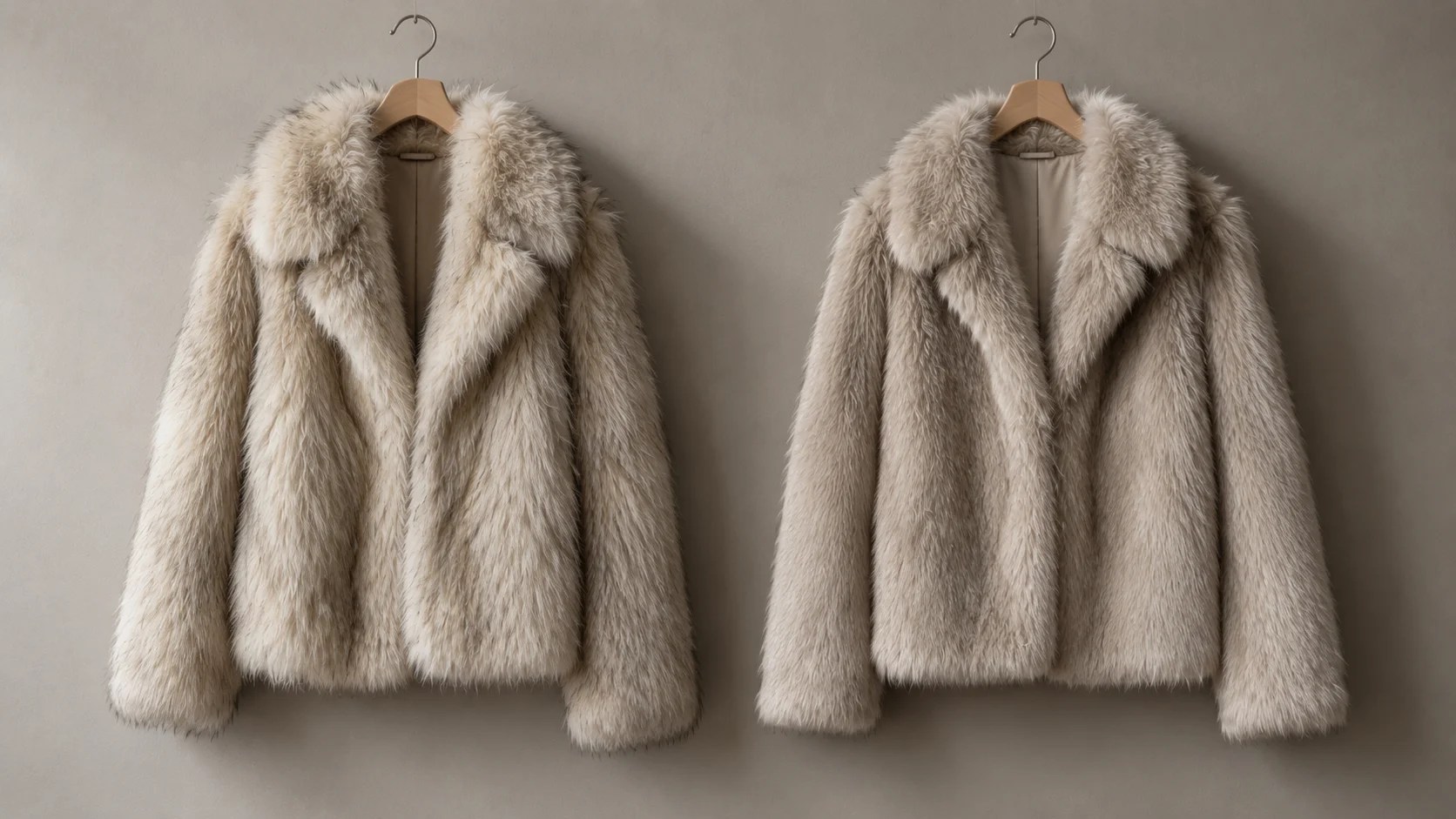
When shopping for a winter coat or jacket, it can be surprisingly difficult to tell whether a garment is made with real fur or faux fur. Modern faux fur can closely reproduce the appearance, softness, and texture of animal fur, while real fur can also be dyed, trimmed, or processed in ways that make identification less obvious.
So, what is the actual difference between real fur and faux fur?
The biggest difference is the material they are made from: real fur comes from animal pelts, while faux fur is a manufactured textile designed to imitate the look and feel of animal fur. That basic difference affects how the materials are labeled, cared for, produced, and perceived by shoppers.
If you’re deciding between a real fur coat and a faux fur coat, understanding these differences can help you make a more informed choice.
Real Fur vs. Faux Fur: The Quick Answer
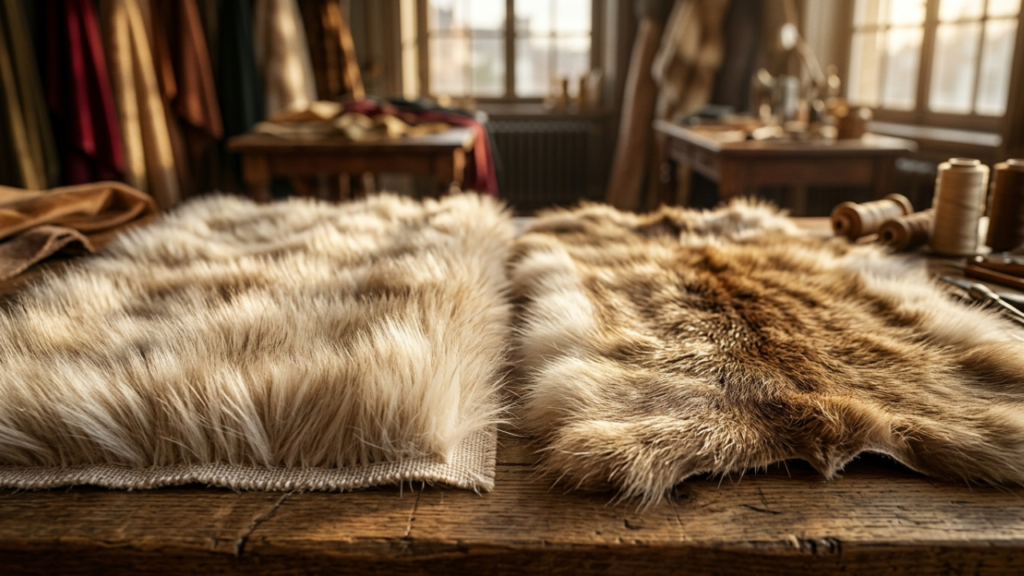
Real fur is made from the pelt of an animal, with the fur remaining attached to the animal’s skin. Faux fur is a synthetic textile created to imitate animal fur, commonly using manufactured fibers.
Real fur and faux fur can look remarkably similar, especially in modern fashion garments. However, they differ in their underlying material, labeling requirements, care considerations, and animal-welfare implications.
For shoppers who want the appearance and texture of fur without purchasing a garment made from an animal pelt, faux fur offers an alternative for coats, jackets, trims, and accessories.
What Is Real Fur?
Real fur is animal fur that has been processed for use in clothing and other products. Common types historically used in fashion include mink, fox, rabbit, chinchilla, raccoon, and other animal furs.
A real fur garment is fundamentally different from a textile because the fur remains attached to animal skin or leather after processing.
This is one of the most useful distinctions when trying to understand whether a fur coat is real.
In the United States, fur products are subject to specific federal labeling requirements. The Federal Trade Commission says fur garments must disclose information including the animal’s name, manufacturer or seller identification, and the country of origin for imported fur products.
That means shoppers should pay attention to product descriptions and labels rather than relying only on how a coat looks or feels.
Why do people buy real fur?
Historically, real fur has been associated with:
- Luxury fashion
- Traditional winter clothing
- Warmth and insulation
- Premium outerwear
- Vintage fashion
- High-end fur coats
- Distinctive natural textures
However, real fur is also controversial because obtaining it involves animals. That ethical consideration is one of the major reasons some consumers specifically look for fashion fake fur, faux fur, or vegan alternatives.
What Is Faux Fur?
Faux fur, sometimes called fake fur or synthetic fur, is a manufactured textile designed to resemble animal fur.
Instead of an animal pelt, faux fur uses a textile backing with fibers attached to create the appearance of fur.
Modern faux fur is available in an enormous range of:
- Colors
- Textures
- Pile lengths
- Patterns
- Densities
- Finishes
- Coat styles
This makes it possible to create everything from a classic faux fur coat to a cropped faux fur jacket, shaggy faux fur jacket, animal-print coat, faux mink fur jacket, or statement winter outerwear.
One advantage for fashion designers is the flexibility of synthetic materials. Faux fur can be manufactured in colors and patterns that don’t naturally occur in animal fur, giving shoppers more choices.
That’s why you’ll find styles ranging from classic black and brown faux fur to pink, white, burgundy, leopard print, and other fashion-forward designs.
Real Fur vs Faux Fur: Key Differences
| Feature | Real Fur | Faux Fur |
|---|---|---|
| Material | Animal pelt | Manufactured textile |
| Animal-derived | Yes | Designed as an animal-free alternative |
| Appearance | Natural fur | Designed to imitate fur |
| Variety | Depends on animal/type | Extremely broad |
| Patterns/colors | Can be dyed or treated | Can be manufactured in many colors and patterns |
| Identification | Label and material inspection are important | Usually identified as faux/synthetic |
| Care | Can require specialized care | Care depends on the specific textile |
| Ethical considerations | Involves animal-derived material | Avoids using an animal pelt |
| Fashion options | Traditional and luxury styles | Jackets, coats, trims, bombers, cropped styles, etc. |
The exact properties of any garment depend on its construction and materials, so shoppers should always check the manufacturer’s product information and care instructions.
How Can You Tell if a Fur Coat Is Real or Faux?

This is one of the most common questions shoppers have when looking at a real fur coat or a faux alternative.
There are several clues that can help.
1. Check the Label First
The label is one of the safest places to start.
For fur products sold in the U.S., the FTC requires specific disclosures for covered fur products, including information about the animal and origin.
If you’re buying online, carefully read the product description rather than assuming that words such as “fur,” “furry,” “fuzzy,” or “fur-like” mean the product contains real animal fur.
Look specifically for terms such as:
- Faux fur
- Fake fur
- Synthetic fur
- Artificial fur
- Vegan fur
The FTC has previously taken enforcement action involving products marketed as faux fur that allegedly contained real fur, demonstrating why accurate labeling matters to consumers.
2. Look at the Base of the Fur
If you already own the garment and can safely inspect it, gently separate the fibers.
Real fur is attached to animal skin, whereas faux fur generally has a textile backing.
Animal-protection organizations describe this difference as one useful way to distinguish the two materials.
However, don’t rely on a single visual test as absolute proof.
3. Look at the Individual Fibers
Natural animal hairs often have tapered ends, whereas synthetic fibers used in faux fur are commonly cut or manufactured differently.
But this is not foolproof.
Real fur may be cut or sheared, and synthetic faux fur can be manufactured to look highly realistic.
Therefore, the fiber appearance should be treated as a clue rather than definitive evidence.
4. Don’t Rely on Price Alone
A common assumption is:
Expensive = real fur
and:
Cheap = faux fur
That isn’t reliable.
Modern faux fur can be premium and expensive, while some products containing real fur may be sold at relatively low prices.
Price alone should never determine whether a garment contains real fur.
What About the Burn Test?
You may find websites recommending a burn test to distinguish real fur from faux fur.
I would not recommend performing a burn test on a garment as a normal shopping method.
It involves an open flame and can damage the item or create unnecessary safety risks. If you’re uncertain about a garment you already own, checking its label, product documentation, manufacturer information, or having the material professionally assessed is a better approach.
Is Faux Fur as Good as Real Fur?
There isn’t one universal answer because “good” depends on what you’re looking for.
If your priority is avoiding animal-derived fur, faux fur has an obvious advantage because it is designed to provide a fur-like appearance without using an animal pelt.
If your priority is traditional natural fur characteristics, real fur is a different material altogether.
For fashion shoppers, however, modern faux fur offers a wide range of options.
You can find:
- Faux mink fur jackets
- Faux fur coats for women
- Men’s faux fur jackets
- Vegan faux fur coats
- Shaggy faux fur jackets
- Leopard faux fur coats
- Faux fur bomber jackets
- Faux shearling coats
- Hooded faux fur jackets
- Vintage-inspired faux fur jackets
This variety makes faux fur particularly flexible for contemporary fashion.
Is Faux Fur Warm Enough for Winter?
This is another important consideration when comparing a real fur coat with a faux fur alternative.
Warmth doesn’t depend solely on whether fur is real or faux.
The overall construction of the garment matters.
Consider:
- Coat length
- Lining
- Fabric density
- Wind resistance
- Fit
- Layering
- Coverage
- Hood design
- Construction quality
- Weather conditions
A well-constructed faux fur coat can be a practical winter fashion layer, but you shouldn’t assume that every faux fur garment provides the same level of warmth.
For particularly cold weather, look at the entire garment rather than judging warmth based solely on the fur’s appearance.
A longer faux fur coat, for example, can provide more coverage than a cropped faux fur jacket, while a hooded style can provide additional coverage around the head and neck.
Faux Fur vs Real Fur: Which Is More Versatile for Fashion?

Faux fur has an important advantage when it comes to fashion variety.
Because manufacturers aren’t limited to naturally occurring animal fur patterns, faux fur can be produced in almost any color or print.
That opens the door to styles such as:
- White faux fur jackets
- Brown faux fur coats
- Pink faux fur jackets
- Red faux fur coats
- Burgundy faux fur coats
- Green faux fur coats
- Leopard print faux fur coats
- Animal print faux fur jackets
- Black faux fur jackets
- Beige faux fur jackets
For shoppers who want a statement piece, this flexibility can be particularly appealing.
A leopard faux fur coat can work as a bold fashion statement, while a neutral beige, brown, cream, or black faux fur jacket can be easier to incorporate into everyday outfits.
What About Faux Fur, Vegan Fur, and Faux Shearling?
These terms are related but shouldn’t automatically be treated as identical.
Faux fur
A general term for manufactured material designed to imitate fur.
Vegan fur
Usually used to emphasize that the product is intended as an animal-free alternative. However, shoppers should still check the actual product materials and brand claims.
Faux shearling
A synthetic material designed to imitate shearling, which has a different appearance and construction from many traditional faux fur fabrics.
For example, a faux shearling coat may have a smooth outer surface with a fluffy interior, while a traditional faux fur coat can have a fur-like pile across the exterior.
Understanding these differences can help you choose the right type of winter outerwear.
Which Is Easier to Care For: Real Fur or Faux Fur?

Care depends heavily on the garment’s specific materials and manufacturer’s instructions.
Real fur can require specialized storage and professional cleaning because its animal-skin backing can be sensitive to moisture and other conditions.
Faux fur has its own care requirements. Synthetic fibers can become matted, flattened, tangled, or damaged by excessive heat depending on their construction.
That’s why you shouldn’t assume that every faux fur jacket can simply be placed in a washing machine.
If you’re wondering how to wash a faux fur jacket, start with the garment’s care label and manufacturer’s instructions.
Never assume that two faux fur jackets require exactly the same cleaning method.
Which Is Better for You: Real Fur or Faux Fur?
The right choice depends on your priorities.
Choose faux fur if you want:
- An animal-free alternative to real fur
- More fashion variety
- Different colors and prints
- Contemporary styling options
- Faux mink or shaggy textures
- Statement outerwear
- A wide selection of jackets and coats
Consider real fur only if:
- You specifically want animal-derived fur
- You understand where the material comes from
- You have reviewed the garment’s labeling
- You are comfortable with the ethical and practical considerations
- You understand the care requirements
For many shoppers specifically searching for an alternative to animal fur, faux fur provides a way to enjoy the visual appeal of fur-inspired fashion without purchasing a garment made from an animal pelt.
What Should You Check Before Buying a Faux Fur Coat?
Before purchasing, don’t focus only on how soft or luxurious the coat looks in photos.
Check:
1. Material information
Look for a clear description of the garment’s materials.
2. Fit
Consider whether you want an oversized, fitted, cropped, or longer silhouette.
3. Length
A cropped faux fur jacket creates a very different look from a full-length or long faux fur coat.
4. Color
Neutral shades such as black, brown, beige, cream, and white can be easier to style, while animal prints and brighter colors can create a statement outfit.
5. Care instructions
Check whether the garment requires special cleaning or storage.
6. Intended use
A fashion-focused faux fur jacket may be ideal for everyday styling, while a longer winter coat may offer greater coverage.
7. Product transparency
Choose retailers that clearly identify what their products are made from.
Transparency matters because consumers should know exactly what they’re buying.
Real Fur And Faux Fur: The Bottom Line
The fundamental difference is simple:
Real fur comes from an animal pelt, while faux fur is a manufactured material designed to imitate the appearance and texture of animal fur.
But the practical differences go beyond the material itself.
They affect labeling, care, fashion options, purchasing decisions, and ethical considerations.
If you’re looking for the appearance of fur while avoiding animal-derived fur, faux fur coats and faux fur jackets provide a wide range of modern alternatives, from classic neutral styles to leopard prints, shaggy textures, faux mink looks, cropped jackets, and statement winter coats.
The most important thing is to buy based on accurate product information rather than assumptions about price, appearance, or terminology.
For shoppers interested in contemporary fur-inspired outerwear, explore our faux fur coat collection to compare available styles, lengths, colors, and textures.
Frequently Asked Questions
Q. Is faux fur the same as fake fur?
Yes. “Faux fur” and “fake fur” are commonly used to describe manufactured materials designed to imitate real animal fur. Product composition can vary, so always check the specific garment’s material information.
Q. How can you tell if a fur coat is real?
Start by checking the label and product information. You can also inspect the base of the fibers: real fur is attached to animal skin, while faux fur generally has a textile backing. Visual tests are not always conclusive, so professional identification may be appropriate if you’re uncertain.
Q. Is faux fur made from animals?
Faux fur is designed as an alternative to animal fur and is generally made from manufactured textile fibers. Always check the specific product’s material composition rather than relying solely on the name.
Q. Is faux fur warm?
Faux fur can be used in warm winter coats and jackets, but warmth depends on the entire garment, including its construction, lining, thickness, length, fit, and layering potential.
Q. Is faux fur better than real fur?
That depends on your priorities. If avoiding animal-derived fur is important to you, faux fur offers an alternative. If you specifically want natural animal fur, the two materials serve different preferences and purposes.
Q. Can faux fur look like real fur?
Yes. Modern faux fur can closely imitate the appearance and texture of several types of real fur. This is one reason shoppers should check labels and material information rather than relying only on appearance.




[…] you’re still deciding between synthetic and animal fur, you may also want to read our guide, [What Is the Difference Between Real Fur and Faux Fur?] to understand the key differences in materials, appearance, care, and purchasing […]
[…] shoppers who are still deciding between animal fur and synthetic alternatives, our guide [What Is the Difference Between Real Fur and Faux Fur?] provides additional information about the differences between the two […]
[…] If you are comparing the two specifically because you want to understand their material differences, read our guide: What Is the Difference Between Real Fur and Faux Fur? […]
[…] If you’re interested in the details, read our related guide: What Is the Difference Between Real Fur and Faux Fur? […]