

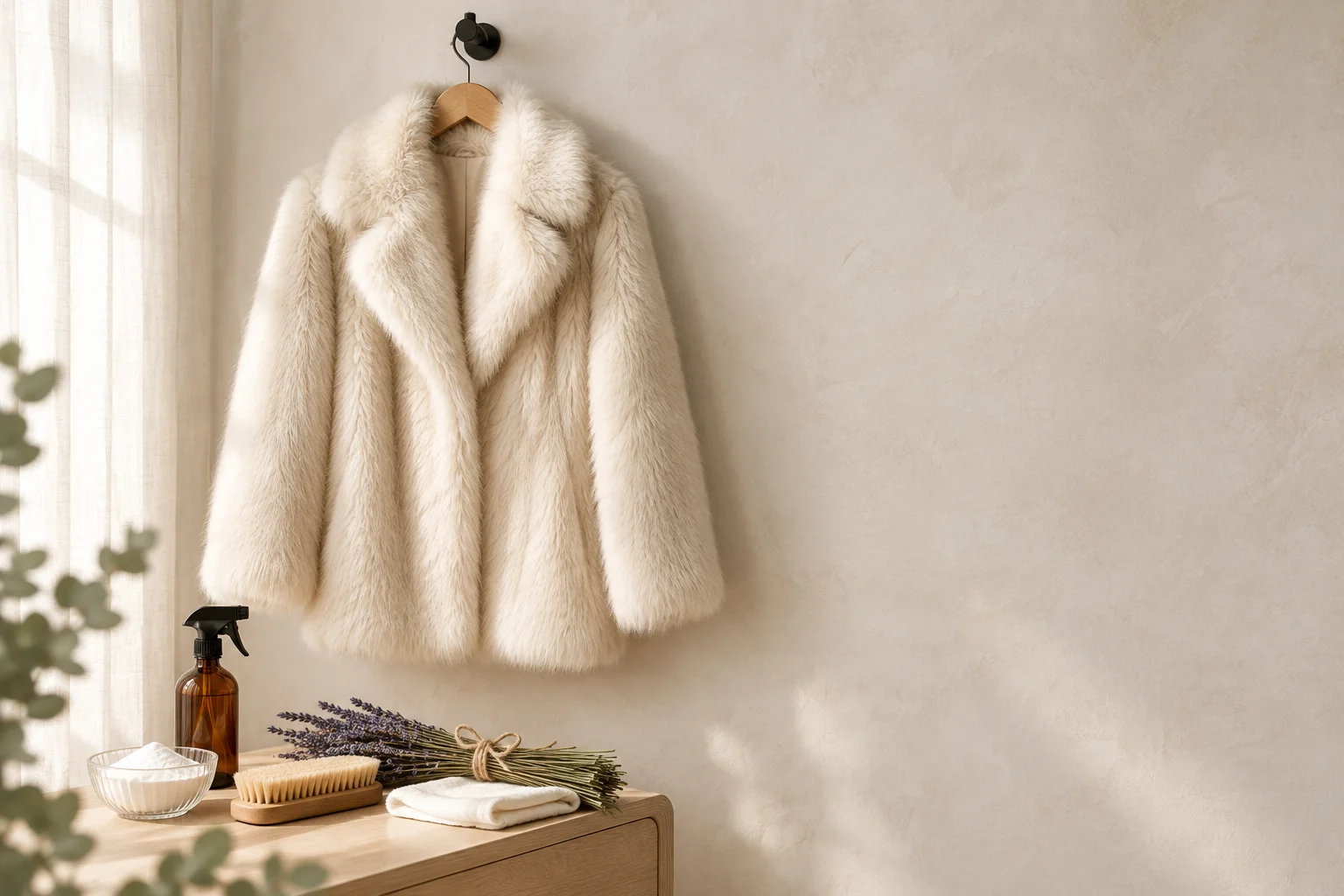
If you’re wondering how to get musty smell out of faux fur coat, the good news is that you usually don’t need to throw the coat away or immediately use harsh chemicals. A musty odor often develops when a faux fur coat has been stored in a damp, poorly ventilated space, exposed to moisture, or left compressed for too long. Because faux fur can have a dense pile, fabric backing, lining, and other components, the safest approach is to remove the odor gradually without soaking or damaging the garment.
The goal is not simply to cover the smell with perfume. You want to air out the coat, identify the source of the odor, clean it according to its care instructions, and dry it completely before storing it again.
Whether you have a shaggy faux fur jacket, a long faux fur coat, a faux mink fur jacket, a cropped faux fur jacket, or a hooded faux fur jacket, the basic process is similar.
Why Does a Faux Fur Coat Smell Musty?
A musty smell usually develops when moisture and poor ventilation are involved.
This can happen when a coat is:
- Stored in a damp closet
- Packed away before it is completely dry
- Kept in a plastic garment bag for too long
- Stored in a basement, attic, or other humid area
- Exposed to rain or snow and then put away
- Stored tightly against other clothing
- Left compressed for an extended period
The odor may come from the faux fur pile itself, the fabric backing, the lining, or a combination of materials.
This is particularly important with synthetic fur because the fluffy pile can be dense enough to restrict airflow. Simply spraying fragrance over the surface may make the coat smell different temporarily without actually addressing the underlying odor.
How to Get Musty Smell Out of Faux Fur Coat
The safest starting point is fresh air and gentle cleaning, not aggressive chemicals.
Before doing anything else, check the coat’s care label. The FTC notes that clothing care labels are important for telling consumers how garments should be cleaned, so the manufacturer’s instructions should take priority over generic cleaning advice.
Then follow these steps.
Step 1: Take the Coat Outside or Into a Well-Ventilated Area
Hang the faux fur coat on a sturdy, wide hanger.
Place it somewhere with good airflow, preferably outdoors in a shaded area or indoors near an open window.
Avoid putting faux fur directly under intense sunlight for long periods. Strong heat or prolonged direct exposure can affect some synthetic fibers, dyes, linings, and backings.
Allow the coat to air for several hours.
For a mild musty smell, this alone may make a noticeable difference.
If the odor is stronger, leave the coat in a well-ventilated location for longer rather than immediately adding cleaning products.
Step 2: Gently Shake and Fluff the Faux Fur
After airing the coat, gently shake it to loosen the pile.
You can also use your fingers to separate compressed sections of the faux fur.
This is especially useful for a shaggy faux fur jacket, faux mink style, or other coat with a dense pile.
Don’t aggressively brush or pull at the fibers.
The objective is simply to restore airflow through the fur-like surface.
If your coat has become flat as well as musty, this step can also help restore some of its original appearance.
Step 3: Check the Lining and Interior
Don’t focus only on the outside.
Turn the coat inside out as much as the construction allows and check the lining, collar, cuffs, pockets, and areas around the underarms.
Sometimes the smell is stronger inside the garment than on the faux fur itself.
If the lining is damp, allow the entire garment to dry completely before attempting additional cleaning.
Do not put a damp faux fur coat directly back into a closet.
That can allow the odor to return.
Step 4: Use a Gentle Odor-Absorbing Method
For a coat that cannot be washed immediately, you can place it in a clean, dry area with an odor-absorbing material nearby.
For example, an open container of baking soda can be placed near the garment—not rubbed directly into the faux fur.
Another option is activated charcoal designed for odor absorption.
Keep the product separate from the garment so powder or particles do not become trapped inside the faux fur pile.
Leave the coat in the ventilated space for several hours or overnight, then air it again.
This is preferable to heavily spraying perfume or deodorizer directly onto a dense faux fur surface.
Can You Use Baking Soda on Faux Fur?
Baking soda is often suggested as a household odor absorber, but you should be careful about putting it directly onto faux fur.
Loose powder can become trapped between fibers and may be difficult to remove completely.
Instead, use baking soda as an indirect odor absorber by placing it in an open container near the coat.
If you are considering any cleaning product directly on the garment, check the care label first and test an inconspicuous area when appropriate.
The same principle applies to vinegar, fabric sprays, essential oils, and commercial odor removers. A product that works on one textile may not be suitable for another.
Can You Spray Perfume on a Musty Faux Fur Coat?
It is better not to use perfume as your primary solution.
Perfume can temporarily mask an unpleasant odor, but it does not necessarily remove whatever is causing the smell.
It can also introduce additional fragrance and residue to the garment.
This is especially relevant for a thick faux fur jacket with collar, hood, cuffs, or dense pile because products sprayed onto the surface may not distribute evenly.
Instead:
- Air the coat.
- Identify whether the lining or pile is the source.
- Follow the care label.
- Clean the garment using an approved method.
- Dry it completely.
- Air it again before storage.
That process addresses the garment rather than simply covering the smell.
How to Wash a Faux Fur Coat That Smells Musty
If the care label allows washing, cleaning may be appropriate.
However, don’t automatically put every faux fur coat in a washing machine.
Different faux fur garments can have different constructions. A coat may contain synthetic fur, fabric backing, lining, interfacing, closures, or other components that respond differently to water and agitation.
If machine washing is specifically permitted, follow the garment’s instructions regarding water temperature, cycle and detergent.
If hand washing is recommended, use the specified method.
If dry cleaning is required, use a professional cleaner and tell them that the garment is faux fur.
What If the Musty Smell Is Coming From Mold or Mildew?
This requires more caution.
A mild stale-storage smell is different from visible mold, mildew growth, persistent dampness, or a strong odor associated with a garment that has been stored in a seriously damp environment.
If you see visible mold or mildew, don’t simply cover it with perfume or household fragrance.
Avoid vigorous brushing indoors because you don’t want to unnecessarily spread contaminated material around your living space.
If the garment is valuable, delicate, heavily affected, or has visible growth, consider asking a professional garment cleaner for advice.
If the backing or lining has been significantly affected by moisture, professional assessment may be safer than experimenting with household cleaning products.
What Should You Avoid When Removing Musty Smells?
When learning how to get musty smell out of faux fur coat, the biggest mistake is trying to remove the odor too aggressively.
Avoid:
Bleach
Bleach can damage dyes, fibers, linings, and other components.
High Heat
Don’t assume a hair dryer, radiator, heater, or clothes dryer will make the process faster.
Excessive heat can affect synthetic materials and garment construction.
Aggressive Scrubbing
Scrubbing can damage the pile or backing and make the coat look rough.
Soaking Without Checking the Label
Water can affect the backing, lining, adhesives, and shape of some garments.
Heavy Fragrance
Perfume and fabric sprays can mask odors rather than solve the underlying problem.
Storing It While Damp
This is one of the easiest ways to end up with the same problem again.
How to Prevent a Faux Fur Coat From Smelling Musty Again

Removing the smell is only half the solution.
You also need to change how the coat is stored.
Before putting your faux fur winter coat away for the season, make sure it is completely dry.
Then:
- Hang it rather than crushing it into a small container.
- Use a breathable garment-storage solution where appropriate.
- Keep it away from damp walls.
- Avoid storing it in a humid basement.
- Don’t pack it away immediately after wearing it in rain or snow.
- Give it time to air before long-term storage.
- Avoid overcrowding your closet.
- Check the garment occasionally during long storage.
If your home has high humidity, improving the storage environment can be more effective than repeatedly treating the coat after an odor develops.
Does Musty Smell Mean Your Faux Fur Coat Is Ruined?
Not necessarily.
A musty smell does not automatically mean the garment is permanently damaged.
If the faux fur remains structurally sound, the lining is intact, and there is no serious mold or mildew problem, careful airing and appropriate cleaning may be enough to restore it.
This is particularly useful for quality garments such as a vintage faux fur jacket, faux mink style, or a coat that you have owned for several winters.
Don’t discard a wearable coat simply because it smells stale after storage.
Try the least aggressive appropriate method first.
Does Faux Fur Absorb Odors?
Faux fur can hold onto odors because the material has a three-dimensional pile rather than a completely flat surface.
Smoke, food smells, perfume, moisture and storage odors can become noticeable in a dense faux fur coat.
The backing and lining can also retain odors.
That’s why simply wiping the outside may not solve the entire problem.
Air circulation is particularly important because it allows odor trapped around the fibers and interior areas to dissipate over time.
How to Get Musty Smell Out of Different Faux Fur Styles

The exact cleaning approach should always follow the garment’s care instructions, but different designs have practical considerations.
Shaggy Faux Fur Jacket
A shaggy pile may need extra time to air because the fibers are long and dense.
Avoid aggressive brushing while the coat is damp.
Faux Mink Fur Jacket
Shorter, smoother faux mink-style fibers can be easier to inspect, but you still need to protect the backing and lining.
Hooded Faux Fur Jacket
Check the hood separately because moisture and odor can remain around the interior seams and neck area.
Faux Fur Lined Jacket
If only the lining contains the odor, cleaning the entire outer garment may not always be necessary.
Cropped Faux Fur Jacket
Because cropped styles are smaller, they may air relatively quickly, but the same care rules apply.
Long Faux Fur Coat
A long coat needs adequate space while airing. Don’t hang it tightly between other garments.
Should You Replace a Musty Faux Fur Coat?
Only if cleaning and professional care cannot reasonably restore it or if the garment has serious damage.
From a practical and environmental perspective, extending the useful life of clothing can be preferable to replacing something that is still wearable.
If you are concerned about the environmental impact of synthetic clothing, you may also want to read: Are Faux Fur Coats Bad for the Environment?
That article can help explain the environmental trade-offs associated with synthetic fur, textile use, garment longevity and disposal.
It is also worth being cautious about broad environmental claims. The FTC says marketers should not make broad, unqualified claims such as “green” or “eco-friendly” without appropriate substantiation.
For consumers, the practical lesson is simple: don’t assume a material is environmentally harmless just because it is marketed with sustainability language.
When Should You Take a Faux Fur Coat to a Professional?
Professional cleaning is worth considering when:
- The care label requires professional cleaning.
- The odor remains after proper airing.
- The garment has visible mold or mildew.
- The lining is heavily affected.
- The coat is expensive or particularly valuable.
- The faux fur has been exposed to significant moisture.
- You are unsure whether a home-cleaning method is safe.
A professional can assess the garment’s construction before applying a cleaning method.
This can be especially important for a complex coat with multiple materials, trims, lining, closures or delicate details.
Faux Fur World: Caring for the Coat You Already Own
At Faux Fur World, our focus is making premium-looking faux fur fashion accessible, including faux fur jackets, faux fur coats and other winter outerwear.
We also position the brand around affordability, aiming to offer premium faux fur at an accessible price point.
But buying a new coat shouldn’t always be the first answer to a problem.
If your existing faux fur jacket has developed a musty smell, try to restore and care for it properly first. Good faux fur care can help you get more use from a garment and keep it looking presentable through multiple seasons.
If you are eventually looking for another style, you can explore our relevant faux fur collection and choose a piece that fits your wardrobe and climate.
Final Answer: How to Get Musty Smell Out of Faux Fur Coat
So, how to get musty smell out of faux fur coat safely?
Start with the least aggressive solution.
Air it out → inspect the lining and pile → gently fluff it → use an indirect odor absorber if needed → follow the care label → clean only with an approved method → dry completely → store it in a dry, ventilated space.
Don’t immediately soak the coat, spray it heavily with perfume, apply bleach, or expose it to intense heat.
And if the smell is accompanied by visible mold, mildew, significant moisture damage, or a persistent odor that won’t disappear, consider professional garment cleaning.
The most important thing is to treat the cause rather than simply masking the smell.
With proper storage and faux fur care, a good faux fur coat can remain a useful part of your winter wardrobe for much longer.
Frequently Asked Questions
Q. How to get musty smell out of faux fur coat without washing it?
Start by hanging the coat in a clean, dry, well-ventilated area for several hours or longer. Gently shake and fluff the pile. You can also place an open container of baking soda or activated charcoal near the coat to absorb odors without putting powder directly into the fur.
Q. Can I use vinegar to remove musty smell from faux fur?
Don’t automatically apply vinegar to faux fur. Check the care label first because different garments have different materials and construction. If the manufacturer does not recommend the method, choose a safer approved cleaning approach.
Q. Can I put a faux fur coat in the dryer?
Only if the garment’s care instructions specifically allow it. High heat can damage some synthetic fibers, linings, backings and garment construction.
Q. Why does my faux fur coat smell musty after storage?
The most common practical cause is exposure to moisture combined with insufficient airflow. A coat that was stored before it was completely dry can also develop a stale or musty odor.
Q. How do I prevent my faux fur coat from smelling musty?
Make sure the coat is completely dry before storage, keep it in a dry and ventilated environment, avoid overcrowding, and don’t store it compressed immediately after wearing it in wet weather.
Q. Should I wash faux fur if it smells bad?
Not necessarily. First check the care label and determine whether the odor can be removed through airing. If washing is allowed and necessary, follow the manufacturer’s instructions rather than using a generic washing method.
Q. Can mold permanently damage faux fur?
Yes, significant mold or mildew exposure can damage textile materials and may require professional assessment. If you see visible growth or the odor is persistent after careful airing, professional cleaning is a safer option.
Q. Does airing out faux fur really work?
It can help with mild storage odors by allowing trapped smells and moisture to dissipate. For stronger odors, airing may need to be combined with an appropriate cleaning method.




[…] you are dealing with a dirty or musty jacket rather than shedding alone, see our guide on how to get musty smell out of a faux fur coat. That article covers odor-related care separately because smell and shedding are two different […]
[…] For more general cleaning advice, see How to Wash Faux Fur Jacket. […]
Comments are closed.